)

)
)
Digital health staff will be expected to gain professional registration
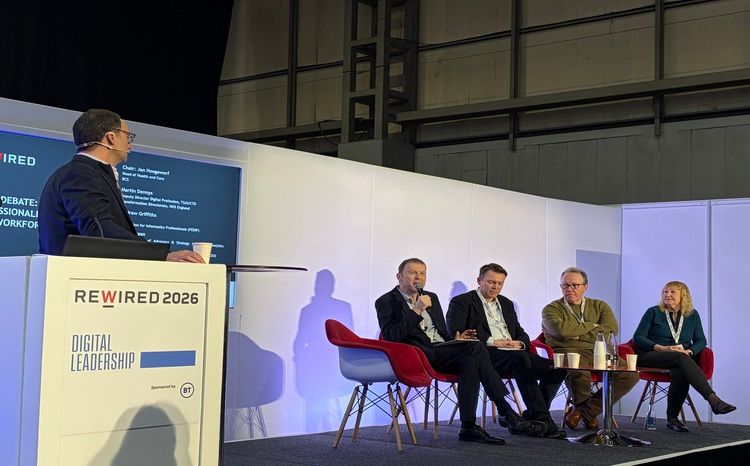
Speaking at the Digital Health Rewired conference, Martin Dennys, deputy director for the digital profession at NHS England, said that a formal announcement was expected to be made within the next few days.
He added that the move is designed “to bring us as a profession, and the activity we do, in line with our clinical colleagues, but also with finance people, knowledge management and other areas that already have a mandate or an expectation set around being professional members”.
Professionalisation of the healthcare digital, data and technology (DDaT) workforce has become an increasingly hot topic as its activities have become ever more central to the delivery of care.
Initially NHSE’s expectation will only apply to senior members of staff, defined in this context as being those at band 7 or above.
Dennys said the expectation would then be extended “in a phased manner” for lower bands.
They will be expected to join one of the five professional bodies that make up the Federation for Informatics Professionals (FEDIP) within the next 12 months, and to take the additional step of becoming FEDIP registered.
“This is not about being part of a professional body for the sake of it.
“It is a commitment to professional standards, to continuing professional development, to ethics, and to our way of working and supporting clinical colleagues and the operational service in what we do,” Dennys said.
The five constituent bodies are: the Association of Professional Healthcare Analysts (AphA); British Computer Society (BCS) – the Chartered Institute for IT; CHIME; CILIP: The Library and Information Association; Institute of Health Records and Information Management (IHRIM); and the Society for Innovation Technology and Modernisation (Socitm).
Professionals will be expected to pay their own membership fees, but Dennys stressed that NHSE had worked with the professional bodies to negotiate a reduced rate for those at lower bands.
Will Smart, chair of the BCS health and care faculty, said: “The professionals we are initially registering are all people who are senior and doing the job, so there will be no requirement on day one for people to take exams. We will credit real world experience.”
Registration with the FEDIP requires an individual to sign up to a code of conduct, demonstrate that they have the skills expected of a digital professional, and to commit to 10 hours of continuing professional development each year.
Andrew Griffiths, chief executive at the FEDIP, said that the new expectation makes it clear that digital professionals are “vital to the running of the NHS”.
“We want to be professionals, we want to demonstrate that, we want to get treated like professionals, we want parity of esteem around the board table when discussions are happening,” Griffiths added.